
Project updates can sometimes create more noise than clarity.
Meetings continue. Reports are issued. Work appears active. Yet the owner may still be unable to answer basic questions about completion, schedule, risk, or responsibility.
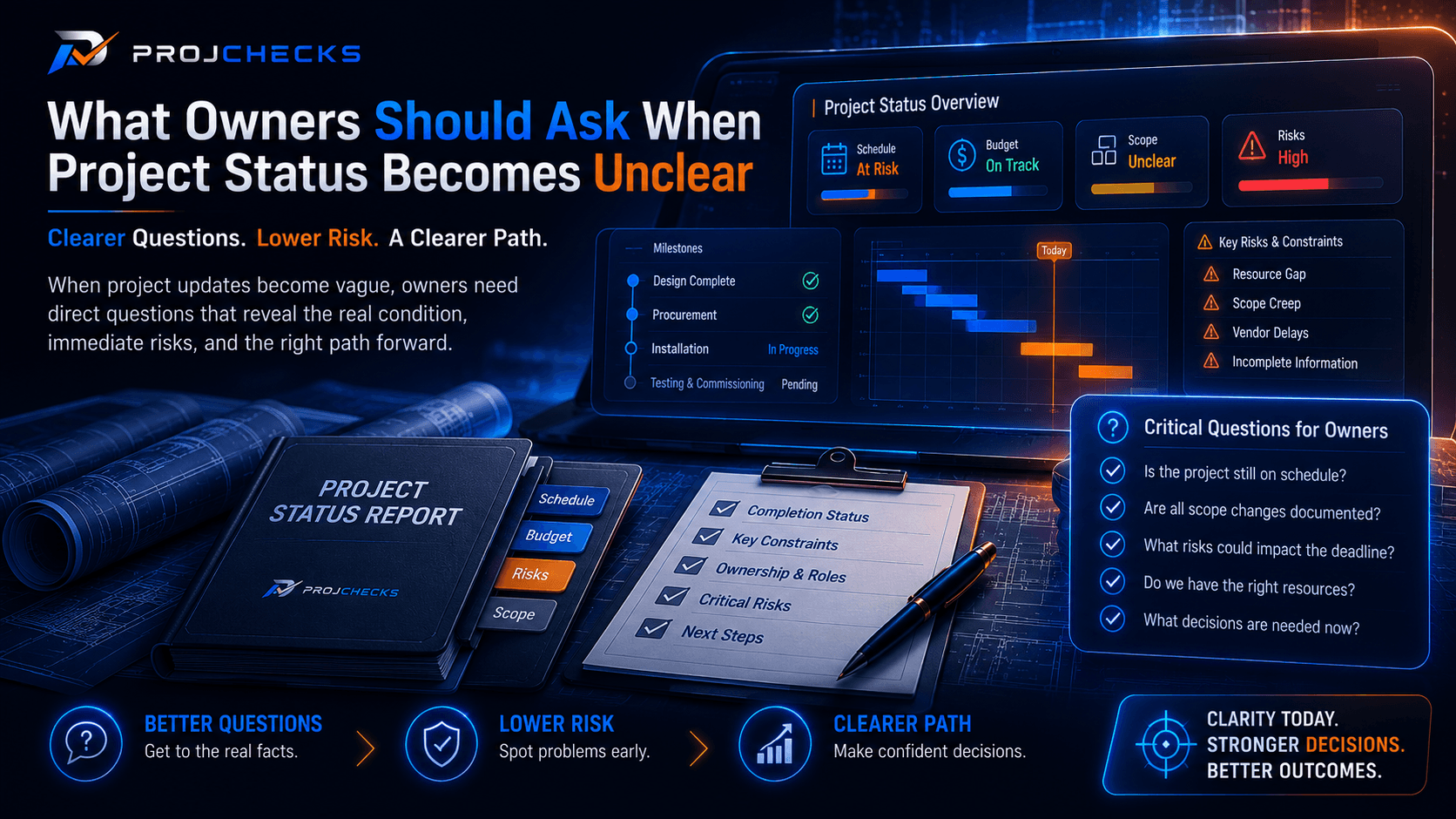
When project status becomes unclear, asking more questions is not always the answer. Asking better questions is.
What Is Actually Complete?
Ask the project team to separate completed and verified work from work that is still in progress, scheduled, awaiting material, awaiting correction, or awaiting acceptance.
• Completed and verified
• Installed but not tested
• In progress
• Scheduled but not started
• Awaiting material or access
• Awaiting correction
• Awaiting owner review or acceptance
Statements such as "almost complete" or "substantially finished" should be supported by measurable information.
What Is Preventing Completion?
Every major open item should have a defined constraint. That constraint may involve material, design, owner decisions, infrastructure, programming, access, third-party coordination, failed testing, or scope change.
Understanding the constraint is more useful than repeatedly asking for a percentage-complete estimate.
Who Owns Each Next Step?
An open item without a clearly assigned owner is unlikely to move consistently.
• The responsible party
• The required deliverable or action
• The target date
• Any dependency
• The impact if the date is missed
This creates accountability without turning the discussion into blame.
Which Dates Are Confirmed?
There is a major difference between a requested date, a forecasted date, a scheduled date, a confirmed date, and a contractual date.
Owners should understand which type of date is being reported and what assumptions support it. A schedule built around unconfirmed material, labor, access, information, or decisions may create false confidence.
What Risks Could Still Affect the Outcome?
Risk reporting should not be limited to problems that have already caused a delay.
• Schedule and sequencing
• Cost exposure
• System functionality
• User readiness and training
• Testing and acceptance
• Documentation and supportability
• Warranty and service obligations
Early visibility gives the owner and project team more options.
What Does the Recovery Plan Require?
When a project is off course, the next step should be more specific than "continue coordinating."
• The current condition
• Immediate priorities
• Required decisions
• Responsible parties
• Realistic dates
• Testing requirements
• Closeout expectations
The goal is not a perfect report. The goal is a practical and credible path forward.
Clear Questions Create Better Decisions
Owners do not need to manage every technical detail. They do need enough reliable information to understand the project condition and make informed decisions.
When reporting becomes vague, inconsistent, or overly optimistic, independent project visibility can help separate activity from progress and establish clearer next steps.
Key Spec Checklist
Pixel Pitch Standard
0.9mm to 1.5mm (Corporate spaces)
Power Configuration
Dedicated 208V 3-Phase Panels
Ventilation Target
At least 2-inch continuous rear air gap
Structure Load Rating
Seismic-certified steel framing
Need technical project validation?
Get an independent review of your technology contracts and specifications before signing.
Related Checkpoint
More professional guidance on enterprise project recovery and execution.



Recover. Realign. Deliver.
Quick Links
© 2026. All right reserved.